The short answer
All three are LAMS approved, low-seat cruisers making about 33–35 kW, so the power is a tie. The equipment is not. The BENDA Chinchilla 500 is the only one of the three with a V-twin engine, belt final drive, a TFT display and traction control, and it adds an upside-down fork, a four-piston front brake caliper and the largest fuel tank. The Honda Rebel 500 and Kawasaki Eliminator both use a parallel twin, a chain, an LCD display and ABS without traction control.
| BENDA Chinchilla 500 | Honda Rebel 500 (CMX500) | Kawasaki Eliminator | |
|---|---|---|---|
| Engine | V-twin, liquid-cooled | Parallel twin, liquid-cooled | Parallel twin, liquid-cooled |
| Capacity | 475.6cc | 471cc | 451cc |
| Power | 35 kW | Not published | 33.4 kW |
| Torque | 42 Nm | Not published | 42.6 Nm |
| Seat height | 705 mm | 690 mm | 735 mm |
| Weight | 215 kg (kerb) | 190 kg (kerb) | 176 kg (kerb) |
| Fuel tank | 16 L | 11.2 L | 13 L |
| Final drive | Belt | Chain | Chain |
| Rider aids | ABS, traction control | ABS | ABS |
| Display | TFT | LCD | Round LCD |
| Suspension | USD fork, twin shocks | 41 mm telescopic fork, twin shocks | 41 mm telescopic fork, twin shocks |
| Price | $10,990 ride-away | $11,499 ride-away (2026 S Edition, Sydney). 2025 run-out stock from $8,999 | $10,926 ride-away (maker’s recommended) |
BENDA figures are BENDA’s own; BENDA prices are one national ride-away figure (NSW excludes CTP). Other makes’ figures are from their Australian pages, listed under Official sources, as checked on 20 November 2026. Their ride-away prices vary by state — check with a dealer.
The engine: the only V-twin here
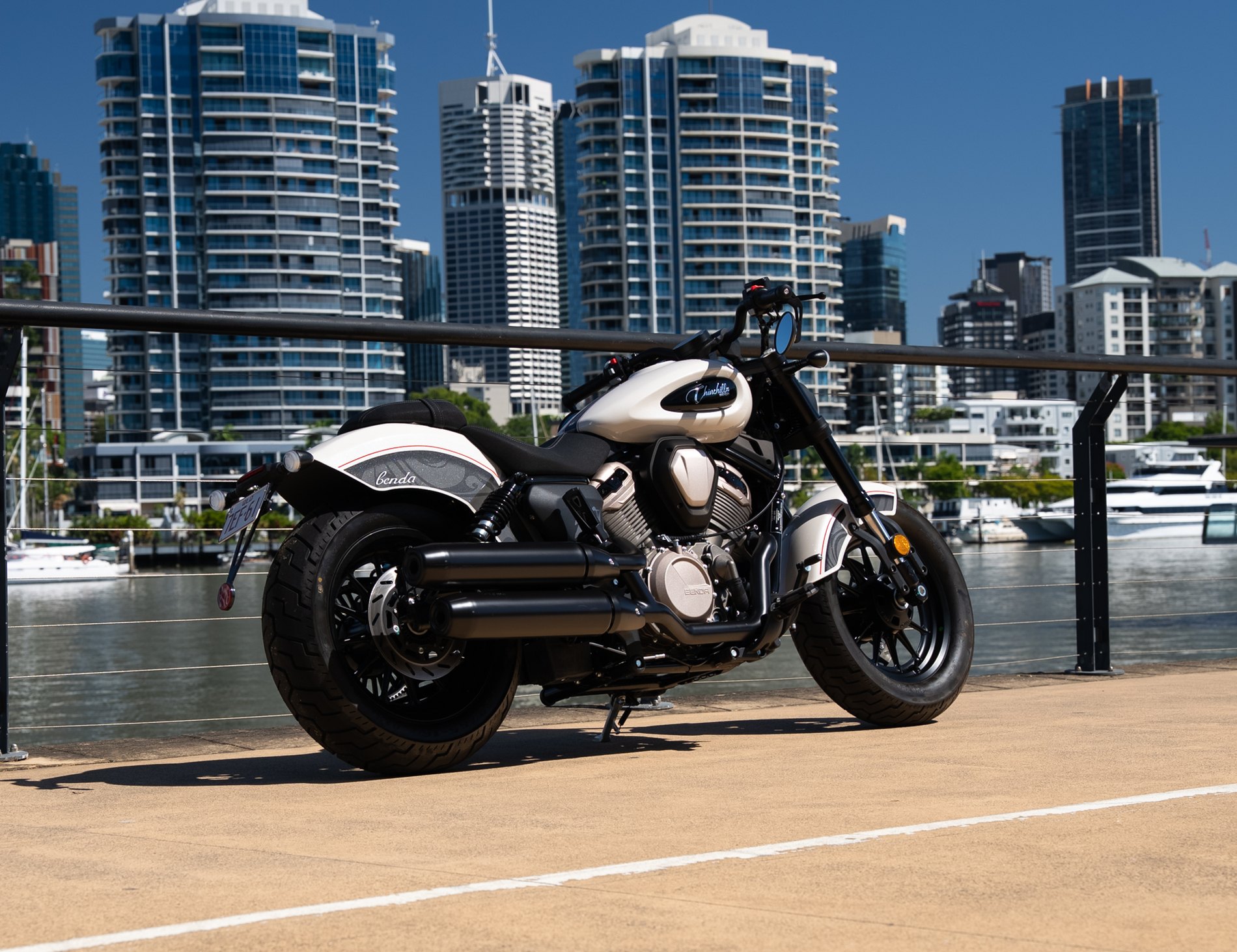
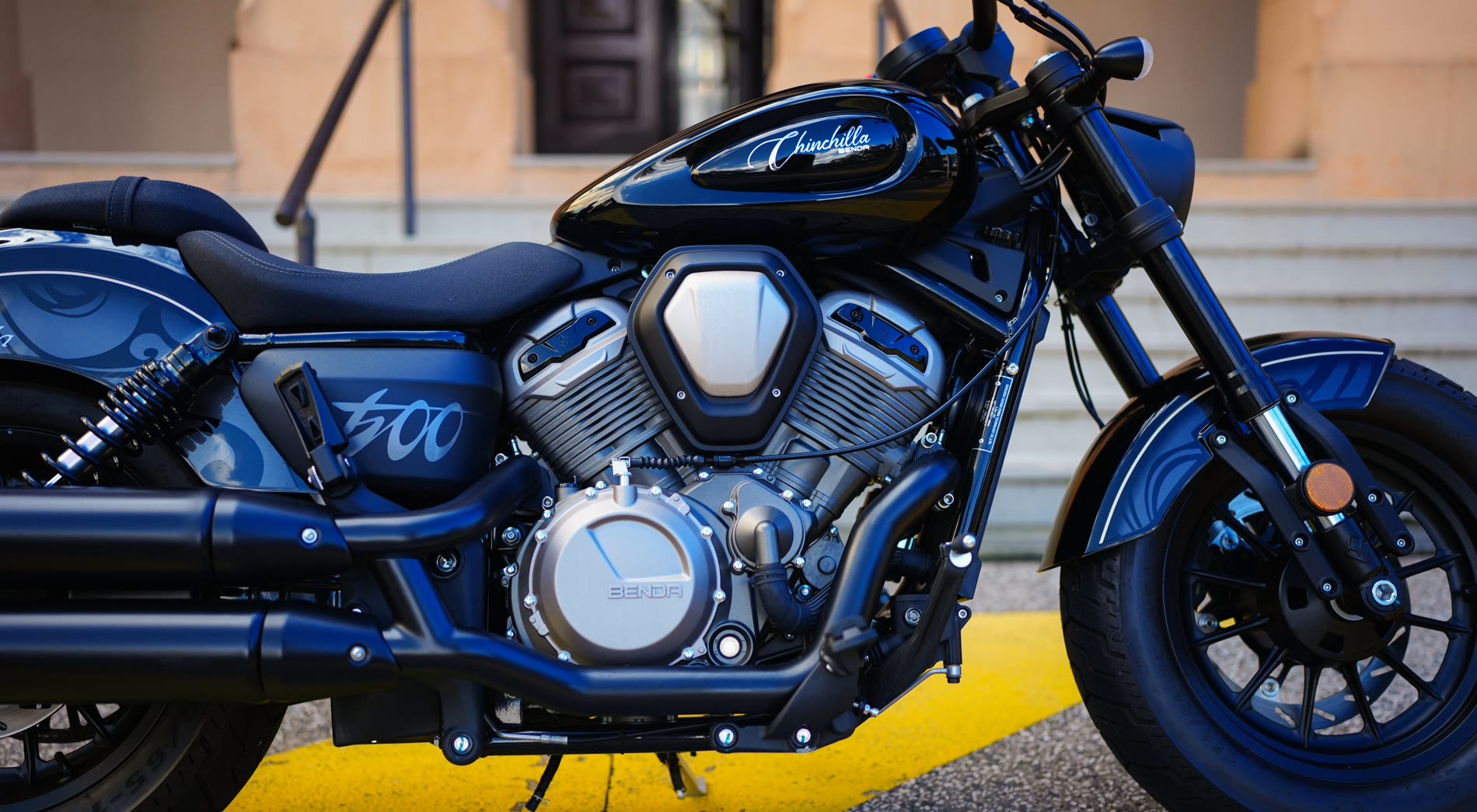
The Chinchilla 500’s 475.6cc liquid-cooled V-twin is the layout people picture when they think of a cruiser — the deep, offbeat pulse and sound a parallel twin cannot reproduce. The Rebel and the Eliminator both use parallel twins: smooth and proven, but with the even, busier note of a commuter engine. The Chinchilla also makes the most peak power of the three (35 kW), with a slipper clutch to smooth hurried downshifts.
It drives the rear wheel with a belt rather than a chain. A belt is quieter, cleaner and needs no lubing or adjusting between services — one less weekend job, and no chain spray on the wheel.
Equipment: where the gap is widest
- TFT display — a modern screen that stays clear in all light. The Rebel and Eliminator use LCD panels.
- Traction control — standard on the Chinchilla, not offered on either rival. For a new rider on a wet roundabout or painted line, it is the aid that matters most after ABS.
- Upside-down front fork and twin rear shocks — the fork layout of far more expensive bikes; the rivals use conventional telescopic forks.
- Four-piston front caliper on a 320 mm disc — the Eliminator uses a twin-piston caliper on a 310 mm disc, the Rebel a 296 mm disc.
- 16-litre tank — around 350 km between fills at the rated 4.5 L/100 km, against roughly 250 km for the Rebel’s 11.2 litres.
Seat height and feel
The Chinchilla’s 705 mm seat lets most riders get both feet flat, close to the Rebel’s 690 mm and well below the Eliminator’s 735 mm. At 215 kg it is the most substantial of the three, which shows on the highway: it sits planted in crosswinds and truck wash where lighter bikes get pushed around.
Price
BENDA sells the Chinchilla 500 at one national ride-away price, the same in every state (NSW buyers add their CTP green slip). Honda lists the current 2026 Rebel 500 S Edition at $11,499 ride-away in Sydney, with leftover 2025 stock on run-out from $8,999 while it lasts; Kawasaki recommends $10,926 ride-away for the Eliminator. Both vary by state. The table above has BENDA’s current price.
If you want the cruiser that sounds and feels like one, with the most equipment in the class, the Chinchilla 500 is the one to ride first.
Official sources
- Honda Australia — CMX500 (Rebel 500): S Edition, LCD instruments, price by postcode
- Honda Australia — CMX500 specifications
- Honda Australia — run-out offers (2025 CMX500 from $8,999)
- Kawasaki Eliminator — manufacturer’s recommended ride-away (Bikebiz)
- Kawasaki Eliminator 2026 — specifications (Brisans)
- Kawasaki — Eliminator 500: round all-digital LCD instruments
- Bikesales — BENDA LAMS models: TFT, ABS and traction control standard
Quick answers
Common questions.
Is the BENDA Chinchilla 500 better than the Honda Rebel 500?
On equipment, yes. The Chinchilla 500 has a V-twin engine, belt drive, a TFT display, traction control, an upside-down fork, a four-piston front caliper and a 16-litre tank. The Rebel 500 has a parallel twin, chain drive, an LCD display, no traction control and an 11.2-litre tank. Both are LAMS approved.
Which LAMS cruiser has a V-twin engine?
Of these three, only the BENDA Chinchilla 500 (475.6cc V-twin). The Honda Rebel 500 and Kawasaki Eliminator both use parallel-twin engines.
Does the Honda Rebel 500 or Kawasaki Eliminator have traction control?
No. Both have ABS but no traction control. The BENDA Chinchilla 500 has both ABS and traction control as standard.
Which 500cc LAMS cruiser has belt drive?
The BENDA Chinchilla 500. The Honda Rebel 500 and Kawasaki Eliminator both use a chain.
How much is a new Honda Rebel 500 in Australia?
Honda Australia lists the 2026 CMX500 (Rebel 500) S Edition at $11,499 ride-away in Sydney, with 2025 run-out stock from $8,999 while it lasts. Prices vary by state.